








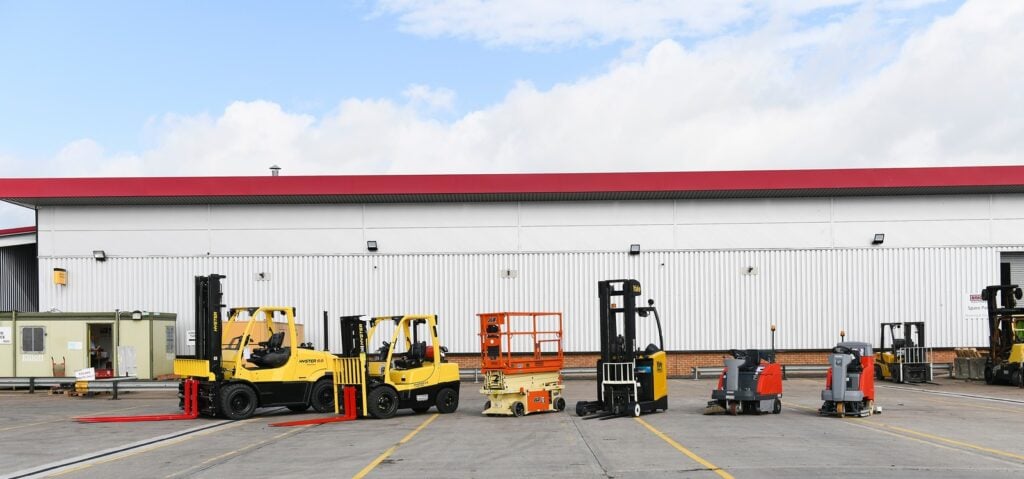
10 Important Safety Tips for Hiring Equipment
Forklift trucks, and other materials handling equipment, are often bought into businesses on a short-term hire basis to cope with spikes in demand and to manage temporary workloads. It’s essential that forklift truck operators approach hired equipment with the same level of care as they would an existing truck.
At Briggs Equipment, we have one of the UK’s largest and most diverse short-term hire fleets, so we know that businesses which go to reputable suppliers for equipment to meet their short-term needs can expect quality, well-maintained machines. However, it’s worth knowing that not all suppliers work to the same exacting standards.
Allan Parsons, National Rental Manager at Briggs Equipment, says:
“There is a lack of awareness that a Thorough Examination – required for all forklift trucks at least every 12 months as specified in the LOLER regulations – is not covered in the rental agreement but is, in fact, the responsibility of the company hiring the equipment.”
“Trucks supplied on a short-term hire basis can be older models, so operators shouldn’t just turn a blind eye if they think that something is not quite right and should always report potential safety issues immediately.”
At Briggs Equipment, keeping people safe is one of our core values. Here are our 10 top tips to help operators stay safe when using hired equipment:
1. Ensure your equipment has been given a pre-delivery inspection
To ensure compliance with LOLER regulations, your equipment should be supplied with a valid Thorough Examination certificate. If it is, you can be sure the equipment has undergone a comprehensive pre-delivery inspection.
2. Do a visual inspection before using the equipment
Check the overall condition of the equipment. If you see dents and paint scrapes, this should set alarm bells ringing. A reputable supplier will always deliver a quality machine that has been looked after properly and is well maintained.
3. Consider the age of the equipment
Be aware that the age of the equipment plays an important part in the safety of the working environment as well as that of the operator. Forklifts built prior to 2002 do not have to be fitted with a seatbelt, for example. However, equipment built after 2010 must have a gate on the hydraulic levers that operate an attachment to ensure the driver cannot accidentally drop the load.
4. Don’t skip pre-shift checks
Before every shift, operators should complete a check of the equipment they’ll be using. Check oil and water levels, look for leaks, test lights and indicators and inspect tyres for cuts as well as general tread condition.
5. Pay attention to warning lights or any abnormal noises.
Turning a blind eye to warning lights can result in damage which is costly to repair. For example, if the oil light comes on, you should stop using the machine immediately. The forklift may be low on oil, or even out of oil completely and continued operation will result in serious damage to the engine.
6. Ask the delivery driver to show you the basic controls
The delivery driver is not necessarily a materials handling equipment expert. However, they should be able to explain how to switch on the machine, operate the mast, fit attachments correctly, etc.
7. Be sure to read the safety guide
Reputable suppliers ensure every machine is delivered with an operator guide that gives clear instructions on general use, completing basic checks, and carrying out simple maintenance. There should also be a clear process outlined for reporting any problems.
8. Double check the truck’s lifting capacity
Equipment attachments, such as fork extensions, rotators and clamps, can impact the lifting capacity of a machine. For example, a 2.5 tonne forklift with a triple lift mast, side shift and forks longer than 1200mm will not be able to pick up a 2.5 tonne load. That’s why it’s crucial to check the truck’s rating plate and the weight of the pallet to ensure the equipment, including any attachments fitted, can handle the intended load safely.
9. Ensure your operator has the correct training and licence
A licence to operate a counterbalance forklift is meaningless if you will be using a reach truck or aerial access equipment. If in any doubt that you are licensed to operate the machine supplied, tell your company’s fleet manager or health and safety manager. Alternatively, contact Briggs Equipment’s expert training team for support.
10. Have a plan in place for emergency support
Reputable suppliers make it easy for operators and fleet managers to report a fault and arrange for an engineer to come out and fix it. At Briggs Equipment, our service telephone number (03301 23 98 23) is on the side of each short-term hire truck. Plus, we guarantee to have an engineer on site within three hours.
For advice on hiring a wide range of materials handling equipment on contracts from a single day up to 12 months, contact Briggs Equipment online, or give us a call on 0800 26 26 81.