










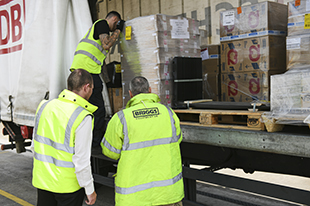
3 workers wearing PPE assessing the best way to handle a pallet in the back of a truck

Guide to Manual Handling Best Practice

When you’re lifting, stacking, or completing other manual handling activity, you’re not just using your hands. You’re using all the tools at your disposal; all the muscles, joints and ligaments in your body.

People with manual handling responsibilities use these tools every day. However, like anything used frequently, people take these tools – muscles, joints, and ligaments – for granted. That’s when accidents are most likely to happen. In fact, handling loads – by pushing, pulling, or lifting – causes more than a third of all industrial accidents every year.

We can and should prevent many of these accidents. The Health and Safety Executive (HSE) state that employers have the legal duty to ‘So far as is reasonably practical, avoid the need for their employees to undertake any manual handling operations at work which involve a risk to their being injured’. It’s therefore in employers’ legal interests to make sure their employees are handling goods and loads safely.

Ensuring safe manual handling processes is also in their economic interests. Injuries cause the loss of millions of working hours every year. On top of this, personal injury cases and compensation packages can prove costly.

Employers could even boost productivity by training their employees to handle loads properly, or by providing materials handling equipment to aid them with the job. Lifting something by hand is hard work; fortunately, today’s employer has solutions to lighten the load.

Rules to remember when manually handling loads.

Keep the load close to your body

The further away the load, the more stress on your lower back. Holding a load at arm’s length puts five times more weight on your back than holding it close to you. Keeping it close to your chest makes you more stable – and the friction of your clothes helps to keep the weight where you want it.

Position your feet correctly

Stand nearby and square on to the load, with your leading leg as far forward as comfortable. Preferably face this leg in the direction you plan to move in next.

Use your leg muscles

If you must bend down to pick something up, don’t stoop – bend the legs, and use your strong leg muscles to take the weight. Handling loads whilst sat down is not a good idea because:

  • you can’t use your leg muscles
  • it prevents you from using your body weight as a counterbalance
  • it puts too much strain on your arms and upper body

Ensure secure footing

You have more power when pulling or pushing if your footing is secure – make sure the floor is dry and solid. Grip the load between waist and shoulder to ease strain on the back and the arms. Even better, turn your back to it and push with your legs: you have strong leg muscles for a reason.

Assess the size of the load

Make sure the load is small enough so that you have both a strong grip and clear visibility . If any side of what you’re carrying – length, width or height– is more than 75cm then you run a greater chance of injuring yourself. Make sure you know where the centre of gravity is; keep the heaviest side nearest to your body.

Don’t carry the load too far

If you can lift a load and carry it easily against your body, you’ll also be able to carry it safely. Don’t carry it too far, however: more than 10m and you’ll probably be using all your energy in carrying the load, and have none left to put it down safely.

Don’t twist

Twisting can hurt your back. Lift, carry and place in one direction where possible. If you must put a load in an exact position, put it down first, and then adjust it, when the weight is off you.

Minimise repetition

Don’t make the same movement too often – it can lead to repetitive strain injury. HSE guidelines allow for lifting or lowering a load once every two minutes. Any more than this, and the employer should be carrying out a manual handling risk assessment. Take a break now and then, or alternate one handling job with another, to give different muscle groups a rest.

A man operating a ride-on pallet truck in a warehouse environment

How can materials handling equipment help reduce injuries?

Employers can reduce the risk of injury to their employees by providing materials handling equipment for moving loads. In fact, the Health and Safety Executive recommend that employees use machines and tools to take the strain. Investing in equipment, such as scissor lifts or moveable, powered workstations, helps employers meet their legal obligation. It protects their workforce from injury, and keeps them safe and fit.

Lifting and lowering

Instead of asking employees to lift and lower items, which involves bending and reaching, get a machine to bring the items to the right height. For example, a scissor lift truck can be loaded with the goods and then raised or lowered to the height needed to transfer the loads safely to the next stage. If the goods are extremely heavy, or must be transported, a powered workstation can do the job efficiently.

Pushing and pulling

The risk of injury may also be reduced if lifting can be replaced by controlled pushing or pulling. However, uncontrolled sliding or rolling, particularly of large or heavy loads, may introduce fresh risks of injury.

A great alternative is a powered pallet truck. Powered pallet trucks are electric battery-operated trucks that move the load without the need for manual effort. They are also available in pedestrian controlled and ride-on options.

Stackers are a high-lift type of pallet truck, and operators typically use them to place and remove loads on storage racking and vehicles. Like powered pallet trucks, stackers also come in manually operated or powered models. Pedestrian controlled and ride-on versions are available.

3 workers completing a manual handling risk assessment checklist

Effectively measure potential handling risks with an assessment checklist

Alongside the duty of reducing the risk of injury to their employees, The Manual Handling Operations Regulations 1992 recommend that employers ‘make a suitable and sufficient assessment of all such manual handling operations to be undertaken by them’. In other words, employers should be checking what risks their handling staff face in their jobs.

We have created a manual handling assessment checklist to help with evaluating the risk of manual handling related injuries.

Download the Assessment Checklist 

How to complete the assessment checklist

The checklist is designed to be as straight forward as possible. Employees can use it as a means of identifying the potential risk of injury from handling loads within your workplace. The checklist should should help by ensuring a systematic examination of all the risk elements, and by aiding the prioritisation of remedial action.

Within the assessment checklist PDF are examples of how to complete the form. The actual checklist may be copied freely or used as the basis of your own checklist tailored for your company. Further checks should be carried out at a later date to ensure that the remedial action to remove or reduce the risk of injury has been effective.


Manual Handling FAQs

Are there different manual lifting guidelines for men and women?

These are guideline weights, and their position in relation to the body, that employees should be able to move, lift and lower easily and safely. If the handler’s hands enter more than one of the box zones during the operation, then take the figure as the smallest weight shown. If employees are handling greater weights than these, then employers should carry out a detailed assessment of the risk of injury

guideline weights for men and women, and their position in relation to the body, that employees should be able to move, lift and lower easily and safely

What are the guidelines for manual pulling and pushing?

The guideline figure for starting or stopping the load is a force of about 20 kg (i.e. about 200 Newtons) for men and about 15 kg (i.e. about 150 Newtons) for women. The guideline figure for keeping the load in motion is a force of about 10 kg (i.e. about 100 Newtons) for men and about 7 kg (i.e. about 70 Newtons) for women.

What types of injuries do manual handling accidents cause?

Here are some of the most common types of injuries caused by manual handling accidents:

  • Back, neck and spine injuries
  • Musculoskeletal disorders (MSDs)
  • Strains and sprains
  • Hernias
  • Hand, foot, ankle and wrist injuries
Scroll to Top