







Picking the right forklift for the task at hand is easy, right?
Actually, you’d be wrong to assume this. There are many types of forklift, as well as fuel types, sizes and lift capacities. Picking the right forklift can save you money by preventing the need for double-handling or can even help you to make the most of current storage space and avoid the need to purchase new premises. As part of our Back To Basics series, we look at the 5 types of forklift you need to know.
What is a forklift?
A forklift, also known as a lift truck or fork truck, is a robust and heavy-duty piece of material handling equipment used for transporting heavy loads. Forklifts can be found in a wide variety of industries, and lifting capacities vary depending on the model. A small forklift or a VNA forklift are ideal for warehouse operations, whereas big trucks are more suitable for larger loads at ports and building sites. Our forklifts fleet at Briggs Equipment includes electric, diesel and LPG options.
Counterbalance Forklifts
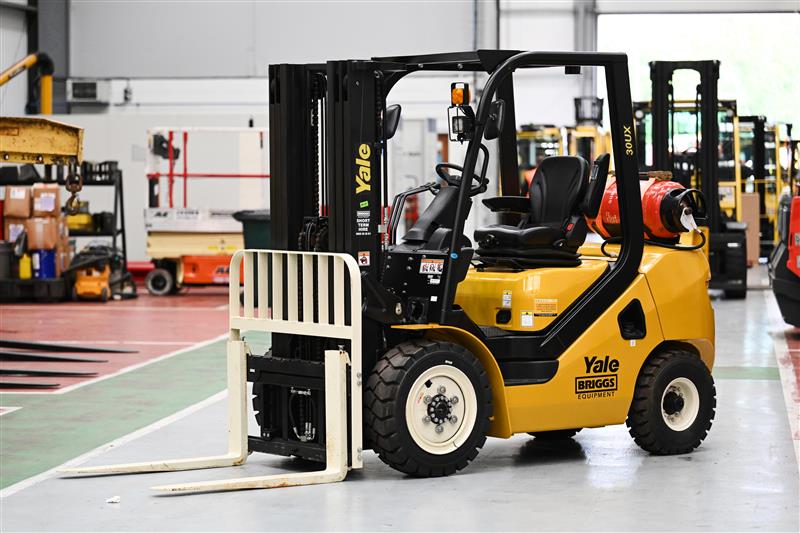
Counterbalance forklifts are equipped with a counterbalance weight which offsets the weight of the load being applied to the forks. This counterbalance weight design is essential in keeping the vehicle stable. With a range of lifting capacities available, they are adept at operating in a diverse range of industries. These versatile lift trucks come in 3 and 4-wheel models. The small, 3-wheel models in particular offer excellent manoeuvrability, making them ideal for indoor storage facilities. Counterbalance forklifts can come in electric, diesel or gas.
Rough Terrain Forklifts
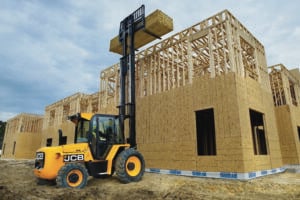
Rough terrain forklifts, or all terrain forklifts, are designed to withstand outdoor conditions and more challenging ground surfaces. Equipped with a powerful engine, and with 2 and 4-wheel drive models, these forklifts can operate on uneven terrain, gravel, mud and wet surfaces. They also benefit from higher ground clearance. A common feature of all-terrain forklift trucks is that the operator seat and cab sit higher up to allow forbetter visibility.
Articulated Forklifts
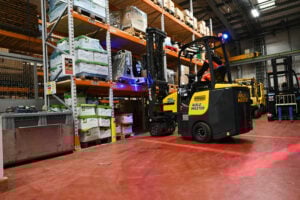
With a pivoting mast design and excellent manoeuvrability, articulated forklifts like the AisleMaster from Combilift are counterbalance forklifts perfect for narrow aisle operations. Available in a range of lifting capacities, their versatile design features a pivoting mast that can access hard to reach spaces without having to rotate the entire machine body. These traits make the articulated forklift an essential piece of warehouse equipment, especially for those with narrow aisle racking. Articulated forklifts offer the versatility of being used indoors or outdoors. They come in electric, diesel or gas so there is a model suitable for any environment.
Side-Loader Forklifts
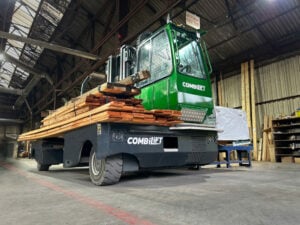
The side–loader forklift is a truck designed to lift awkward, long and heavy loads from the side rather than the front. With the forks or platform located parallel to the side of the cab, their design allows more space to distribute the weight of the load. This design also makes it easier to fit long loads through doorways. Sideloaders can also be multi-directional forklifts, which have a smaller turning radius and can operate across a variety of environments. A common feature of the sideloader forklift is for the operator cab to be positioned close to the front of the vehicle. With these machines primarily used for transporting long loads, the positioning of the cab is vital in ensuring optimal visibility for the operator. You’ll often find that these vehicles have a higher ground clearance than other lift trucks. This is so they can operate across a range of surfaces.
Discover more about how Combilift have embraced efficiency needs with the creation of the world’s first autonomous sideloader.
VNA Forklifts
What is a VNA forklift? VNA stands for very narrow aisle forklift. It is a small lift truck that is perfectly suited to confined spaces, making it the perfect warehouse equipment. With a small turning radius, these forklifts are a perfect option for warehouses. They allow you to have narrower aisles so that you can create more usable storage space, maximising your current facility’s potential instead of moving to bigger premises. VNA forklifts are a very efficient and cost-effective warehouse solution.
What else should I consider when hiring a forklift?
Do you need a licence to drive a forklift truck?
Yes, but good news, you can book your forklift training course from Briggs Equipment. You can learn more about what we offer by visiting our Training page on our website or contact our team today.
How Can I Track My Forklifts?
With a fleet management system (FMS) like Opta Fleet or BE Portal, you can track the usage and performance of your forklifts. Whether you have a single forklift truck or many of them, an FMS allows you to see usage hours, maintenance shedules and more.
Should I purchase a new or used forklift?
Both new and used models offer clear benefits to businesses. It largely depends on your budget and future business intentions. Our team of experts are here to offer advice and help to find the right machine for your business. If you’re thinking about hiring a pre-owned forklift, learn more from our guide, Key Considerations For Buying A Used Forklift.
When buying a forklift you should weigh up the total cost of ownership. You can contact us and we’ll use our TCO calculator to go beyond the purchase price to show the bigger picture with fuel costs, maintenance and more. This information can help to identify the most cost effective solution to meet your needs.
Do I Need Training To Drive A Forklift?
Training is always strongly advised for operating any form of equipment, especially in the workplace. Above all, the right training will help maintain high standards of safety for you and your team. Taining is also beneficial for implementing best practices and driving efficiency of your processes when using the machinery. You can learn more about forklift training courses in our essential introduction to MEWP and forklift truck training.
Does my forklift need to be inspected?
Yes, every forklift needs valid certification to comply with safety standards in the UK, a common example of this is a LOLER (Lifting Operations and Lifting Equipment Regulations). Forklifts need to undergo a thorough examination every 12 months for general use, such as lifting materials. However, if a truck is used to lift people, it must be inspected every 6 months. You can get your LOLER inspection through Briggs Equipment’s repairs and maintenance services.
Learn more about why forklift servicing matters.
Need To Hire A Forklift?
If you are looking to rent a forklift or other forms of MHE, our experts can help you prepare. Discover more about what you need to know before you hire a forklift or other MHE.
We’re here to help
Our team of experts will help find the best machine to suit your needs. Explore our short term hire product selector or contact us today to discover how we at Briggs Equipment can support your business, wherever you are in the UK.
Tel: 03301239850
Email: info@briggsequipment.co.uk